
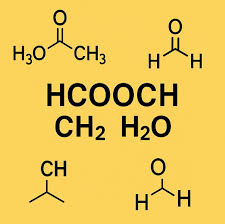
The chemical expression HCOOCH CH2 H2O may appear cryptic to the untrained eye, but it represents a fascinating chemical system that bridges the gap between organic chemistry, esterification reactions, and hydrolysis processes. When broken down, this formula points toward the interplay between formic acid derivatives (HCOOH) and hydroxy or methylene groups (CH2 and H2O), which are fundamental in several organic transformations, especially those involving esters and carboxylic acid derivatives. Chemistry at this level is not just about memorizing formulas; it’s about understanding how atoms rearrange, bonds break and form, and how molecules interact under different conditions.
The combination of HCOOCH, CH2, and H2O indicates possible ester hydrolysis or formation reactions, where water interacts with organic compounds to yield alcohols and acids. This principle is central to both industrial chemistry and biochemistry, from the synthesis of fragrances to the metabolism of lipids in living organisms. In this comprehensive article, we’ll explore what HCOOCH CH2 H2O stands for, its structural interpretation, its formation pathways, properties, reactions, mechanisms, and wide-ranging applications in real-world contexts.
1. Understanding the Formula HCOOCH CH2 H2O
To start, we must first decode the expression HCOOCH CH2 H2O. In organic chemistry, every subscript and symbol carries meaning. The portion HCOOCH suggests a formate or ester linkage, where formic acid (HCOOH) reacts with an alcohol or a hydroxy-containing compound. The CH2 unit indicates a methylene group, commonly seen as a bridge in many organic compounds, while H2O refers to water, which often participates as a reactant or product in these reactions.
In essence, this formula represents a reaction scenario rather than a stable standalone molecule. For instance, it may describe the hydration or hydrolysis of methyl formate (HCOOCH3) or an intermediate where water interacts with a formate ester containing a CH2 group. Thus, HCOOCH CH2 H2O symbolizes a point in a chemical transformation where formic acid esters and water participate in equilibrium.
In organic chemistry, understanding such formulas allows chemists to predict reaction outcomes, control mechanisms, and manipulate conditions to obtain desired products. The representation also highlights the balance between organic and inorganic components, as water, although inorganic, plays a critical catalytic role in organic processes.
2. The Structural Significance of Each Component
2.1 The Formate Group (HCOO–)
The HCOO segment is derived from formic acid (HCOOH), the simplest carboxylic acid. The formate ion or group serves as a building block for esters and salts, forming compounds like methyl formate (HCOOCH3), ethyl formate (HCOOC2H5), or formate salts such as sodium formate (HCOONa). The presence of this group often imparts a distinct reactivity toward nucleophiles and bases, as the carbonyl carbon in HCOO– is electrophilic and susceptible to attack.
Formate derivatives are essential in organic synthesis because they serve as formylating agents and intermediates in hydrogen storage reactions. They also occur naturally in metabolic pathways such as the one-carbon metabolism cycle.
2.2 The CH2 (Methylene) Group
The methylene group (–CH2–) acts as a connecting or bridging unit in countless organic structures. In the case of HCOOCH CH2 H2O, it suggests the link between the ester portion and possibly another substituent or functional group. The methylene group contributes hydrophobic character, flexibility, and reactivity, depending on its environment. It can also undergo oxidation, substitution, or polymerization reactions, forming more complex organic molecules.
In larger molecular systems, the CH2 group’s electronic influence can stabilize or destabilize reaction intermediates. Its versatility is a cornerstone of organic reaction design, influencing rates, product distribution, and molecular conformation.
2.3 The Role of Water (H2O)
Water is often overlooked in chemical equations, yet it serves as the universal solvent and a key reactant in countless reactions. In HCOOCH CH2 H2O, water’s presence hints at hydrolysis, hydration, or condensation processes. Hydrolysis involves water breaking chemical bonds, typically converting esters or amides into acids and alcohols. Conversely, condensation uses water removal to form larger molecules.
Water also affects reaction equilibrium and reaction rate, acting as both a reactant and a medium. In ester hydrolysis, water attacks the carbonyl carbon, forming a tetrahedral intermediate that eventually splits into an acid and an alcohol.
3. Formation Pathways: How HCOOCH CH2 H2O Can Arise
The compound or mixture described by HCOOCH CH2 H2O can be envisioned as forming through multiple routes, depending on the intended chemistry. Let’s discuss a few possibilities:
3.1 Esterification Reaction
One pathway involves esterification, where formic acid reacts with a hydroxy compound (for example, methanol or ethanol) to produce an ester and water:
HCOOH+CH3OH→HCOOCH3+H2OHCOOH + CH3OH → HCOOCH3 + H2OHCOOH+CH3OH→HCOOCH3+H2O
Here, methyl formate (HCOOCH3) and water are formed. If we consider CH2 as part of a chain, the generalized version could be:
HCOOH+CH2OH–R→HCOOCH2R+H2OHCOOH + CH2OH–R → HCOOCH2R + H2OHCOOH+CH2OH–R→HCOOCH2R+H2O
This explains the formula HCOOCH CH2 H2O, symbolizing an esterification reaction involving a CH2-bearing alcohol.
3.2 Hydrolysis Reaction
Alternatively, the process may describe hydrolysis, where an ester reacts with water to regenerate the acid and alcohol:
HCOOCH2R+H2O→HCOOH+HOCH2RHCOOCH2R + H2O → HCOOH + HOCH2RHCOOCH2R+H2O→HCOOH+HOCH2R
In this reversible reaction, the ester bond breaks due to water’s attack, returning to its starting components. Such hydrolysis reactions are central to biochemistry (lipid breakdown) and industrial organic chemistry (soap making, biodiesel production).
3.3 Intermediate Step in Organic Synthesis
In synthetic organic chemistry, intermediates like HCOOCH–CH2–H2O may appear transiently when one part of the molecule is partially hydrated or protonated during acid or base catalysis. These intermediates may not be isolable but are crucial for understanding reaction kinetics and transition states.
4. Physical and Chemical Properties
Understanding the characteristics of the entities involved in HCOOCH CH2 H2O gives insight into how they behave under different conditions.
4.1 Physical Properties
-
State: Most formate esters (like methyl or ethyl formate) are colorless, volatile liquids with pleasant odors.
-
Solubility: They are moderately soluble in water because of their polar ester group but can also mix with many organic solvents.
-
Boiling Point: Ranges between 30–55°C for light esters, reflecting weak intermolecular hydrogen bonding.
-
Density: Typically around 0.9 g/cm³, less than water.
4.2 Chemical Properties
-
Reactivity: Esters are prone to hydrolysis, reduction, and transesterification.
-
Stability: They are generally stable under neutral conditions but hydrolyze in the presence of acid or base.
-
Combustion: Highly flammable, producing carbon dioxide and water.
-
Polarity: The carbonyl oxygen and ester linkage make them polar, contributing to moderate dipole moments and reactivity toward nucleophiles.
5. Mechanisms of Reaction Involving HCOOCH CH2 H2O
To truly understand this formula, we must explore the mechanistic pathway — what happens at the molecular level when these species react.
5.1 Acid-Catalyzed Ester Hydrolysis
-
Protonation of the Carbonyl Oxygen: Acid donates a proton to the carbonyl oxygen, making the carbon more electrophilic.
-
Nucleophilic Attack by Water: Water attacks the carbonyl carbon, forming a tetrahedral intermediate.
-
Proton Transfer and Cleavage: The intermediate rearranges, expelling the alcohol and regenerating the acid catalyst.
-
Products: Formic acid (HCOOH) and an alcohol (e.g., HOCH2R) are formed.
This mechanism is reversible; under dehydrating conditions, esterification can occur instead.
5.2 Base-Catalyzed Hydrolysis (Saponification)
-
Hydroxide ion attacks the carbonyl carbon.
-
The tetrahedral intermediate forms and collapses.
-
The alkoxide is expelled, forming a formate salt (HCOO–).
-
Subsequent acidification yields formic acid.
The base-catalyzed route is irreversible, as the carboxylate anion is more stable.
6. Industrial and Laboratory Applications
The chemistry surrounding HCOOCH CH2 H2O finds use in various sectors of chemistry and manufacturing.
6.1 Industrial Synthesis of Esters
Formate esters such as methyl formate and ethyl formate are produced industrially via esterification reactions similar to the one represented by HCOOCH CH2 H2O. These esters are used as solvents, flavoring agents, and intermediates in chemical manufacturing.
6.2 Hydrogen Storage and Fuel Chemistry
Formates are important in hydrogen storage technologies, as they can release hydrogen gas upon catalytic decomposition. Compounds containing formate and CH2 groups serve as potential carriers for renewable energy systems.
6.3 Organic Synthesis Intermediates
Formate esters act as intermediates in the synthesis of more complex chemicals, pharmaceuticals, and polymers. Their mild reactivity makes them useful for controlled reactions, especially in multi-step organic synthesis.
6.4 Biochemical and Environmental Relevance
In biology, formate compounds appear in metabolic processes related to one-carbon metabolism and the degradation of formaldehyde. Environmentally, understanding their hydrolysis and degradation pathways helps in pollution control and green chemistry innovations.
7. Safety, Handling, and Environmental Impact
Chemicals related to HCOOCH CH2 H2O, such as methyl or ethyl formate, are generally safe at low concentrations but must be handled carefully.
7.1 Safety Precautions
-
Work in well-ventilated areas to avoid inhalation.
-
Use gloves and goggles; formate esters can irritate skin and eyes.
-
Avoid open flames — esters are flammable.
7.2 Environmental Considerations
-
These compounds degrade rapidly in the atmosphere.
-
Biodegradation yields carbon dioxide and water, minimizing persistence.
-
However, improper disposal can contaminate waterways, so regulated waste management is essential.
8. Analytical Methods and Detection
Chemists analyze compounds like HCOOCH CH2 H2O or its components using:
-
Infrared Spectroscopy (IR): Detects carbonyl (C=O) and O–H stretching.
-
NMR Spectroscopy: Reveals hydrogen and carbon environments, identifying CH2 linkages and ester groups.
-
Mass Spectrometry (MS): Confirms molecular weight and fragmentation patterns.
-
Gas Chromatography (GC): Separates and quantifies esters and reaction mixtures.
9. Modern Research and Technological Importance
In modern research, the chemistry symbolized by HCOOCH CH2 H2O plays roles in:
-
Green Chemistry: Using water as a solvent and reactant to minimize hazardous waste.
-
Catalysis: Developing acid or enzyme catalysts to improve esterification efficiency.
-
Energy Research: Employing formate-based fuels and hydrogen carriers.
-
Polymer Chemistry: Creating biodegradable polyesters and materials from simple esters.
10. Theoretical and Computational Chemistry Perspective
Computational chemists model molecules like HCOOCH CH2 H2O to understand energy profiles, transition states, and bond dynamics. Density Functional Theory (DFT) calculations predict reaction barriers, confirming experimental findings and helping design new catalysts that operate efficiently under mild conditions.
Frequently Asked Questions (FAQ)
Q1: What does HCOOCH CH2 H2O represent?
It represents a chemical system or reaction involving formate esters and water—often related to esterification or hydrolysis.
Q2: Is HCOOCH CH2 H2O a single molecule?
Not exactly. It’s best understood as a shorthand notation indicating the coexistence of formate, methylene, and water components in a reaction mixture.
Q3: What type of reaction produces such a combination?
Esterification between formic acid and alcohols or hydrolysis of formate esters in the presence of water.
Q4: Where is this chemistry used?
In industries producing solvents, fragrances, plastics, and biofuels; and in biochemical systems for energy metabolism.
Q5: Is it safe to handle?
Yes, with precautions. Many esters are volatile and flammable; handle in ventilated labs using safety equipment.
Q6: How is water important here?
Water is both a reactant (in hydrolysis) and a product (in esterification). It influences equilibrium and reaction kinetics.
Q7: Does this reaction occur naturally?
Yes. Hydrolysis and esterification occur in biological processes such as fat metabolism and fermentation.
Q8: How do scientists detect or study it?
Using spectroscopy (IR, NMR), chromatography (GC), and computational simulations.
Conclusion
The expression HCOOCH CH2 H2O encapsulates an elegant aspect of chemistry: the interaction between organic molecules and water through reversible esterification and hydrolysis reactions. Though the formula may look simple, it embodies some of the most vital principles in both industrial organic chemistry and biological systems. The balance between acid and alcohol, formation and breakdown, hydrophobic and hydrophilic forces drives much of the chemistry that sustains industries and life itself.
From producing esters for perfumes and fuels to mimicking nature’s metabolic pathways, understanding this type of chemical relationship deepens our appreciation for molecular science. As research advances, chemists continue to find greener, safer, and more efficient methods to exploit these reactions — ensuring that the chemistry of compounds like HCOOCH CH2 H2O remains central to innovation, sustainability, and progress.
